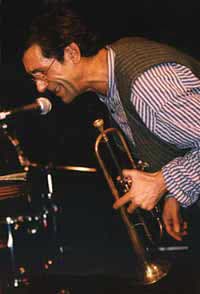
In 1970 he graduated from the Leningrad Conservatory in trumpet, studying composition as an elective.
He is the organiser of, and a participant in, a number of ensembles playing contemporary improvised music.
From 1979 to 1995 he performed in a duo with the double bassist Vladimir Volkov; in 1995 he formed a quintet, and since 1997 he has performed in a duo with the accordionist Evelina Petrova.
As a trumpeter and composer he has performed many times at jazz festivals in Russia, Europe and the USA.
He has recorded more than ten CDs, including "Jazz Raga" (Leo Records, London, 1987), "Russian Songs" (Zurich, 1989), "Post Factum" (St Petersburg, 1998) and "Chonyi Together" (London, 1998).
He is the author of the books "The Trumpet School" and "At the Entrance to the Temple" (a study of modal systems in folk music), teaches the course "Theatre of Musical Improvisation", and has presented programmes on Christian radio.
His compositions include the cycle "Chagall", 24 preludes and fugues, "Children's Album" for piano, "The Decline of Europe" and "Steppenwolf" for symphony orchestra, chamber music, transcriptions of works by Bach and Mozart, the Gospel recitatives in the collective project "St Matthew Passion 2000", and music for plays, ballets and five films, among them "The Last Waltz" and "Mexican Fantasy".
"Vyacheslav Gaivoronsky is a composer, bandleader and trumpeter who occupies a special place in the elite of our new jazz. For several years running, at the end of the Soviet era, when nationwide polls of jazz critics were still held, those same critics named Gaivoronsky 'jazzman of the year', that is, the country's best jazz musician. Perhaps one should not take such polls too seriously, since our jazz criticism to this day suffers from every Soviet ailment, and that country no longer exists, but still... A paradoxical leader, well known only to a narrow circle of connoisseurs and musicians and valued only by them, Gaivoronsky, seemingly in the shadow of the noisier Chekasin, Kuryokhin or Alperin, nevertheless enjoys unquestioned authority in the new jazz milieu. He has no regular tours in the West, only individual concerts and festival appearances, and at home there is no abundance of work either; nor are there that many recordings: two full LPs and a few pieces on compilations in the USSR (as it then was), one 'serious' CD in Russia, and a couple of English CDs on Leo Records, but again in company. Yet everything he does, and he does a great deal (dozens of concert programmes, only a small fraction of which are documented, theatre and film music, works for various line-ups, the teaching of young musicians), always finds a listener who may be few in number but is interested and grateful. Call it 'music for musicians', but it is music that not only exists in today's momentary cultural space, which is of course very important, but creates tomorrow's music and tomorrow's audience." N. Dmitriev