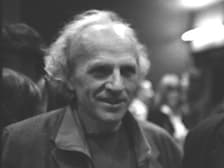
Vladimir Tarasov was born on 29 June 1947 in Arkhangelsk and has been making music for forty years. Having started with traditional jazz in the Arkhangelsk seamen's club at the age of 14, over the years he has passed through almost every style and genre of musical art. Vladimir Tarasov has worked in the most varied orchestras: brass, theatre, symphony and chamber, and has performed concertos for percussion and symphony orchestra written especially for him. Today he continues to work with the chamber orchestras of Liana Isakadze and Vladimir Spivakov and with Mark Pekarsky's percussion ensemble. But free jazz and new improvised music have always been his main pursuit. Vladimir Tarasov is the permanent member of one of the first (if not the first) and most significant ensembles of this kind in the recent history of Soviet jazz, the G-T-Ch trio (Ganelin-Tarasov-Chekasin), which already in the early seventies managed to produce an extremely new and original fusion of composed and improvised music, and in the late seventies was the first to break through the Iron Curtain.
Almost 20 years ago Vladimir Tarasov began performing and recording solo programmes for percussion. All of them are called ATTO, which in Italian means "act", and to date ten programmes have been made, eight of them released on LP and CD. Vladimir Tarasov's solo percussion music for acoustic and electronic drums has shifted more and more over time towards contemporary academic music and avant-garde sound installations. In recent years Tarasov has collaborated actively with many well-known musicians. In a duo with Andrew Cyrille he recorded a CD and made several major tours of Russia, Canada and the USA; he has performed many times in Butch Morris's Creative Music Orchestra, and has played and recorded with the ROVA Saxophone Quartet, the Baltic jazz project "Baltica-91" and Christian Muthspiel's Octet Ost. A few years ago Tarasov assembled under his direction a kind of new jazz "national team" of Lithuania, the Lithuanian Art Orchestra, whose first programme, "WaltzAtto", also came out on CD. But Vladimir Tarasov takes an active part not only in musical life but in artistic life of a far wider range. He writes music for theatre and cinema ("Black Square" and "Don Juan"), stages performances and sound installations at art exhibitions and in galleries together with his artist friends Yuri Sobolev, Ilya Kabakov and others (Documenta 9, Kassel 1992; "Watermusic, or Accident at the Museum", New York 1992; the Museum of Contemporary Art, Chicago 1993; "Red Pavilion", Venice Biennale 1993, and many others), and performs with poets and writers, among them Dmitry Alexandrovich Prigov and Andrei Bitov. In a word, Vladimir Tarasov lives a rich creative life and is today in a period of especially intense artistic activity.
Vladimir Tarasov's sound images live in chance regularities, where the fate of the drummer and the laws of the gods hold sway. He listens and looks into them, entering into dialogue like a Zen Buddhist at a tea ceremony. Their chance, or aleatorics, rhymes with roulette, materialising in its real play-objecthood, where the winnings are unpredictable but luck is always on your side. Vladimir Tarasov's aleatoric performances go back to the tradition of Mozart's improvisations for a game of dice; they are washed by the spaces of Cage and Stockhausen, Wassily Kandinsky and Daniil Kharms. In its unpremeditatedness and permissiveness this alternative game lets his life flow freely, leaving in its images the patterns of the Chinese Book of Changes. In their configurations the magic incantations of Dmitry Alexandrovich Prigov meet the postmodern strategies of Andrei Bitov, the high parody of Alexander Pushkin and the Soviet folk neo-baroque of Vasily Chapaev, the tragic constructivism of Vsevolod Meyerhold and the optimistic rotors of Marcel Duchamp. Vladimir Tarasov's aleatorics in the festival project of the DOM centre permeate the avant-garde cinema of Europe and Russia, giving back a voice to the silent films of Dziga Vertov and Luis Buñuel. The paper installation in which Vladimir Tarasov the artist meets Vladimir Tarasov the composer confirms the phrase that fell from the sky, that manuscripts do not burn, and that the rustle of paper sheets is comparable to the rustle of angels' wings. The sheets of the installation "Nocturne for Paper" fill with the breath of the Great Text, the flicker of meanings and streams of light, where shadows and contours remind us that the chances of play never vanish from our lives.