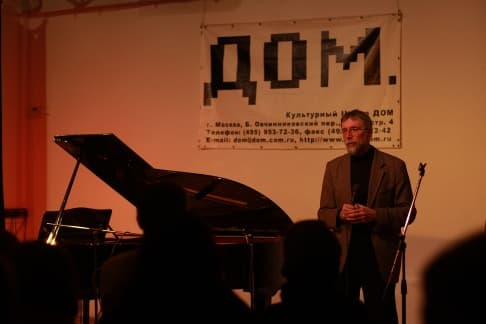
Vladimir Martynov was born in 1946. He graduated from the Moscow Conservatory, studying composition in 1970 (in Nikolai Sidelnikov's class) and piano in 1971 (in Mikhail Mezhmulov's class).
Martynov showed himself to be an outstanding composer already during his student years. His talent was highly appreciated by Nadia Boulanger, who became acquainted with his work in Moscow.
Martynov began his career as a representative of the avant-garde, one of the most radical among Soviet composers in this field. His dodecaphonic and serial works of the early 1970s demonstrate refined technique, intellectual artistry, and a high level of musical craftsmanship.
Martynov's creative image reflects his wide range of interests. He studied 20th-century music as well as the music of the Western Middle Ages and the Renaissance, and published a series of monographic collections devoted to Heinrich Isaac, Guillaume de Machaut, Andrea Gabrieli, John Dunstable, and Guillaume Dufay (1976–1980), arranged for instrumental ensembles.
As a folklore collector and researcher, he undertook expeditions to various regions of Russia and Central Asia, including the Northern Caucasus, Central Pamir, and mountainous Tajikistan. In 1973 he began working at the Moscow Experimental Studio of Electronic Music. His interest in electronics coincided with an intensive study of Eastern religions and cultures, as well as Christian philosophy of both East and West.
Martynov created a number of electronic compositions that marked the culmination of his avant-garde period and reflected new aesthetic, ethical, and spiritual orientations.
The years 1976–1978 were particularly productive and important for his artistic development. His transition from the hyper-constructivism of the avant-garde to "new simplicity" signified a turn toward minimalism and religious themes, incorporating elements of minimal music, historical styles and genres, and the aesthetics of art rock.
In 1975–1976 Martynov participated in concerts with an early music ensemble (recorder), performing Italian, French, and Spanish works of the 13th and 14th centuries.
In 1976–1977 he performed with the Moscow Soloists Ensemble (piano and electronic keyboards), presenting avant-garde, electronic, and minimal music by composers such as Cage, Stockhausen, Ligeti, Riley, Feldman, Silvestrov, Artemyev, Martynov, and Pärt, as well as music of the Western European Middle Ages.
In 1977–1978 Martynov founded his own rock group, Outpost, serving as its leader, composer, and keyboard player. The band performed in concerts and festivals during these years.
In 1978 Martynov temporarily ceased composing and devoted himself to religious life. In 1979 he began teaching at the Theological Academy of the Trinity–St. Sergius Lavra.
He engaged in the deciphering and restoration of ancient Russian liturgical chant and studied old chant manuscripts in various monasteries. He also composed music for church services in accordance with ancient canons.
In 1984 Martynov returned to composition, working in canonical, postmodern, and minimalist styles and employing the technique of bricolage. Notable works from this period include Come In!, Jeremiah's Cry, Apocalypse, A Night in Galicia, Magnificat, Requiem, and Exercises and Dances of Guido. At the same time, he became active as a writer, publishing several books and numerous articles on religious, philosophical, historical, and cultural topics, and participating in academic conferences.
Since 2002 Martynov has organized an annual festival: in 2002 it was titled The Dances of Kali-Yuga; in 2003, The Zone of Opus Posth; in 2004, The Zone of Posth Opus Posth; and in 2005, Objects and Figures (The Interior After the Orgy).
Prominent theatre directors have staged productions using Martynov's music, including Anatoly Vasiliev (Mozart and Salieri — Requiem, Ilias, Song 23), Yuri Lyubimov (Apocalypse, Go and Stop Progress), and Ilya Eppelbaum (The Seasons).
Martynov composed Folk Dance for the Kronos Quartet (2002), Hymn of Moscow University (2005), and Dedication to Singapore (2005).
He became a laureate of the Russian National Award in 2003 and participated in the World Theatre Olympiad (Moscow, 2001 — Apocalypse) and the Trialogus Festival (Tallinn, 2005 — The Play of Angels and Human Beings), among others.
Since 2003 Martynov has been actively involved in multimedia projects, collaborating with artists such as Dmitry Prigov, Lev Rubinstein, the rock group Auktyon, and Leonid Fedorov.
In 2005 he published the book The Zone of Opus Posth: The Birth of a New Reality.
In 2006–2007 he composed the music for the film The Island (Ostrov), directed by Pavel Lungin.
In 2008 he published Jacob's Motley Rods: A Private View of the General Festival of Life.