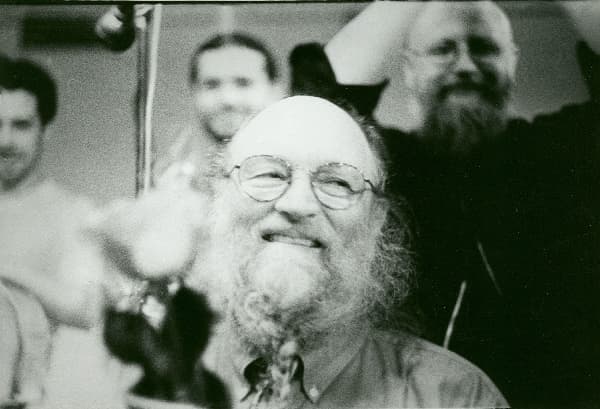
Terry Riley, the pioneer of minimalism, is one of the most revolutionary composers of the post-war era. In 1964 he wrote his most famous work, "In C", which became a landmark and secured the arrival of a new musical form based on constantly repeated musical fragments. It changed the musical course of the twentieth century and influenced the work of such well-known composers as Steve Reich, Philip Glass and John Adams, and of the groups The Who, The Soft Machine, Tangerine Dream, Curved Air and many others. His hypnotic, multi-layered, polymetric, brilliantly arranged and orchestrated improvisations, spiced with Eastern elements, prepared the ground for the public's broad interest in the New Tonality.
Terry Riley was born on 24 June 1935 in Colfax, California, and began giving solo piano concerts in the 1950s. Under the influence of John Coltrane and John Cage he took up the study of open improvisation and the avant-garde, and in 1960 wrote "Mescalin Mix", a piece made of tape loops of assorted recorded noises.
By the early sixties Riley was regularly staging extended solo performances that began at 10 pm and continued until sunrise, obvious forerunners of the all-night raves that appeared decades later. After graduating from Berkeley in 1961 his next major work was "Music for the Gift" (1963). The so-called loop effect aroused Riley's interest in repetition as a means of musical expression, and in 1964 he completed his most famous minimalist work, "In C".
At the same time he was learning the saxophone, using the instrument in his so-called "night flights"; these grand improvisational performances became the basis for the albums "Poppy Nogood and the Phantom Band" (1968) and "A Rainbow in Curved Air" (1969).
In 1970 Riley made the first of many trips to India to study with the vocal master Pandit Pran Nath, with whom he often performed in later years; and his collaboration with John Cale led in 1971 to the album "Church of Anthrax", which is widely known well beyond the circle of experimental music connoisseurs.
Teaching at Mills College in Oakland in the seventies, Terry supported David Harrington, the founder and leader of the Kronos Quartet, and this was the beginning of a long collaboration that has produced 13 string quartets, the quintet "Crows Rosary", the concerto for string quartet "The Sands", and the multimedia piece "Sun Rings" (2003) for choir, visual imagery and the sounds of space.
Another joint work by Riley and the Kronos Quartet, "Salome Dances for Peace" (1989), was named classical album of the year by USA Today and was even nominated for a Grammy.
In 1992 Terry Riley created the small theatre company Travelling Avant-Garde to perform the chamber opera "The Saint Adolf Ring", based on the divinely mad drawings, poetry, letters and mathematical calculations of Adolf Wölfli, the twentieth-century Swiss artist who suffered from schizophrenia.
The new millennium began with a tour by Terry Riley's new group, the All Stars, with George Brooks (saxophones), Tracy Silverman (violin and six-string viola), Gyan Riley (guitar) and Stefano Scodanibbio (double bass).
In May 2000 Terry visited Russia for the first time with solo piano concerts, performing at the Sergey Kuryokhin Festival in St Petersburg, at the Moscow Conservatory and at the DOM cultural centre. The newspaper Izvestia wrote that "Terry Riley is the greatest composer and pianist since Prokofiev", and the London Sunday Times named him one of the 1,000 principal creators of the twentieth century.