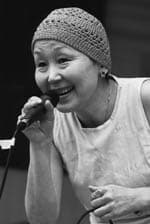
Karma, or simply fate...
In 1957, the Year of the Rooster by the Eastern calendar, somewhere in the lost steppes of Central Asia, in the mysterious land called Tuva, in a small settlement of gold prospectors, I was born into a family of village teachers.
In their youth my parents loved to play musical instruments: my father the seven-string guitar, my mother the mandolin. My father had a soft baritone and often sang his own songs with amateur groups at concerts around Tuva.
After working for a time at a primary school in a small village, they decided to move to Khem-Beldir, the old name of the capital of the Tuvan republic, now the city of Kyzyl, in order to continue their education.
I remember how on Sundays my father would work with us, teaching us three sisters to sing and dance, and my mother, looking out of the kitchen, would ask with a smile: "Aren't you tired? Maybe continue next weekend? Dinner is ready."
What else do I remember of those times?
At home my father loved to read his poems to my mother and me; we were always his first listeners and critics. He loved, now and then unexpectedly, to interrupt the course of everyday affairs with a burst of love and admiration. Only now do I understand how strongly he knew how to love life, and how important it was for him sometimes to step aside in this way from ordinary daily business and from urgent, pressing reports from the scene.
It was on the day of women's solidarity, 8 March 1966. After graduating from the pedagogical institute my father had been appointed political commentator of TASS at the newly opened Tuvan television. That day he read to us with inspiration one of those long, complex poems that I, still a very small girl, found hard to understand. Trying to catch the meaning of the words, I gazed through the window at the beads of lamps glowing on the bridge in the night and thought: "When I grow as big as papa, I will travel across that bridge far, far away and read my own poems too."
Many years later that dream was destined to come true.
In 1987 my "Tale of Chai-Suu" was published in the Tuvan literary almanac "Ulug-Khem". It was a real triumph for my father. He showed his colleagues in the journalists' guild the little note about his daughter and the tale printed in the magazine. He proudly declared that the world would yet see his daughter's books, and that his elder daughter would yet manage to astonish the world with her talents, because she was the first-born in the family, a child born of the first impulse of love, when young hearts are joined not by family ties but rather by the single impulse of the intimacy of the first night.
I needed an education; I went to Moscow and for a time drifted far from my literary searching. Life in the capital swept me up and spun me round; I gave birth to a daughter and entered a music college. After graduating from the Ippolitov-Ivanov Music College I continued my education at the Gnesin Institute in Moscow. At the time I was fascinated by the search for rare ethnographic material, by the study of scholarly works and books on the archaic ritual music of the oldest traditions of the peoples of Siberia, and on the various kinds of traditional throat and overtone singing among the peoples of Central Asia. That is why the "geography" of the songs of my first performance on a professional stage in 1986 consisted of the songs of the peoples of Siberia: the Nganasan, Itelmen, Koryak, Nivkh, Tofalar, Nanai, Buryat, Tuvans and Russians, a kind of kaleidoscope of long-forgotten ancient mysteries and of the syncretic art of song performance.
My highly successful appearance in 1986 at the All-Russian Competition of Folk Song Performers in Krasnodar had a great resonance. I received the second prize and the special Irma Yaunzem prize. In 1987-1988, in a group with other artists, I had the good fortune to present my art in Spain, Canada, America, Australia, the Philippines and New Zealand. At the same time I began to take an interest in, and often play with, musicians performing improvised music, in which I found it very interesting to mix ancient traditions with the experimental basis of improvisation.
...everything was covered with a layer of freshly fallen fluffy snow, sparkling in the bright sun like diamonds framing the fragile beauty of the magnolias in bloom. All the greenery, the flowers, the houses, the streets were covered in snow. Otscha, the highest mountain not far from Schaan, glittered against a dazzling blue sky, and it seemed to me that the mountains were greeting us with a silent hymn of the joy of love.
We lived very harmoniously. Georg was very tender towards my daughter; together we organised jazz mini-festivals and concerts in Tuva, invited musicians from Austria, Switzerland and Germany, arranged meetings with local musicians, and also gave improvisation lessons for children. All in all, life was very full and interesting in every respect.
With the birth of my grandson in 1999 I again found the time and the interest to write something. That is how the poems and literary sketches collected in this book were born.
I would like to dedicate this first collection of poems to the memory of my father, Okan-ool Kyrgysovich Namtchylak, who wrote his articles and poems under the pen name Vitaly Eikhem. Thank you, papa! I have grown up to your dream of publishing a book.
P.S. Some of the texts in Russian and Tuvan have already been released abroad by record companies. I should note that I write not only in Russian and Tuvan but also in English, and that I also work in the field of experimental poetry and sound performance.
To list all the extravagant and intriguing projects, musically and aesthetically, in which Sainkho has taken a direct part would be pointless, for they are countless. There were the performances with the avant-garde group TRI"O" in the early nineties. There was the album recorded with Evan Parker in May 1996 at the Music Gallery in Toronto. Performances with Butch Morris, Ned Rothenberg and Andreas Vollenweider, with whom she released the joint album "Book of Roses". And her participation in the international action "Multivoice Tuva" in 1996 in Moscow, together with Vladimir Chekasin (saxophone), Mikhail Zhukov (percussion), Daniil Kramer and the American percussionist Jason Kahn.
Source: From the author's preface to her first collection of poems, Krasnoyarsk, 18 August 2005