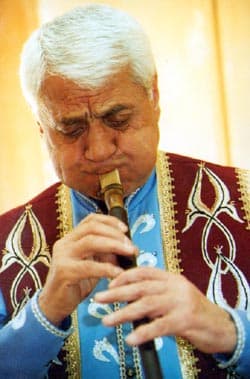
Djivan Gasparyan was born in 1928 in the village of Solag near Yerevan. At six he began to play the duduk on his own and to learn the basics of the art by listening to the old masters. In 1948 Djivan Gasparyan joined the Tatul Altunian National Song and Dance Ensemble, and in the same year gave his first professional performance as a soloist with the Yerevan Philharmonic Orchestra. The repertoire of Gasparyan's duduk initially consisted of traditional Armenian folk songs, although he also composed original songs to the poetry of Vahan Teryan.
Fame among Western audiences came to Gasparyan gradually, after Peter Gabriel's soundtrack to "The Last Temptation of Christ", in which the duduk was woven into classical and rock themes. Since then, in less than ten years, Djivan Gasparyan has scored seventeen films, among them "The Russia House", "Gladiator", "The Crow" and Alexander Gutman's documentary feature "Frescoes". The soundtrack to "Gladiator", on which Djivan Gasparyan was co-author with the composer Hans Zimmer, received the Golden Globe for best film score in 2001. Djivan Gasparyan has played on Peter Gabriel's albums and released a record on Real World, the world's leading folk label. Pirated copies of his discs are easy to find on the Mitino market stalls, where they lie next to bootleg Deep Forest, Era or Sacred Spirit. "If only they did it well!" Gasparyan fumes. As a professor at the Yerevan Conservatory, Djivan Gasparyan has trained more than 70 professional duduk players.
Djivan Gasparyan tours intensively in Europe, Asia and America. After a 15-year break he performed in Moscow in 2002, and in St Petersburg he gave several sold-out concerts. His record of the most beautiful Armenian folk songs and ballads, "I Will Not Be Sad in This World", dedicated to the memory of the victims of the earthquake in Armenia, won worldwide recognition.
Four times (1959, 1962, 1973 and 1980) Gasparyan won the gold medal of the world-famous competition organised by UNESCO. Gasparyan is the only musician to whom the government of Armenia awarded the title of People's Artist of Armenia, in 1973.
Gasparyan has performed with the Kronos Quartet and the Vienna, Yerevan and Los Angeles symphony orchestras, and has worked with such musicians as Lionel Richie, Brian Eno and Peter Gabriel. Together with Michael Brook he recorded the album "Black Rock".
The duduk is an Armenian cylindrical wooden flute. Western scholars trace its existence back more than 1,500 years, while Soviet Armenian musicologists found evidence that the instrument was born 1,200 years ago. Its range is only one octave, yet it requires a certain skill to play, its dynamics being controlled by constant adjustment of the lips and fingers. It has eight finger holes and one thumb hole. Invented in the third century, the instrument was slightly modernised in the 1920s and today exists in two main varieties (whose pitch differs by a whole tone). In Armenia the duduk has always been made from apricot wood and comes in three sizes. The smallest is 28 cm long with a 9 cm reed; the middle model is about 33 cm with a 12 cm reed; and the largest is 40 cm with a 14 cm reed. The tuning is essentially unfixed and diatonic, although a range of notes can be found by partially closing the holes. The instrument belongs to a specific type of double-reed pipe. In Armenia the reed is made from cane, which grows in abundance on the banks of the river Araks.
The duduk has a warm, soft, slightly nasal timbre and is used in folk songs and dance music. At least two players can play together, the second instrument holding a drone called the dam; that player is called the damkash.
The duduk that Djivan Gasparyan plays has been with him for forty years. The maestro also plays the zurna, the shvi and the clarinet, and sings in a high voice.
Djivan Gasparyan died on 6 July 2021 in Yerevan, aged 92.