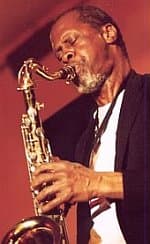
Free jazz is not only its stars. In the sixties the ideas of free improvisation seized the imagination of many Black musical revolutionaries. Those who were noticed by audiences and critics, released records and appeared at festivals are only the tip of the iceberg. Many remained unknown, and some have only recently emerged from deep shadow. Charles Gayle is one of those figures.
Who said that legendary personalities in jazz belong entirely to the past? Gayle is a fine example of a living legend. Why a legend? Gayle is certainly a vivid, powerful and unusual tenor saxophonist and composer. But that is not even the point: it is hard to find anyone else in contemporary jazz with such an unusual life, one that he built himself, by his own lights and according to his own views, on life and on music alike.
Charles Gayle belongs to the generation of Ayler, Shepp, Cherry and Tchicai, and could be a younger brother to John Coltrane: he was born in 1939 in Buffalo, New York. There is a share of Cherokee blood in his veins. Evidently such a Native American and African American heritage favours musical talent and an extravagant life in equal measure; think of a guitarist named Jimi Hendrix. But back to our hero: on his own, without anyone's help, Charles taught himself to play the saxophone and the piano. His first models were Bud Powell and Parker, then Monk. In time he settled on his instrument, the tenor saxophone, and chose his creative credo: self-expression, experiment, complete inner freedom. No wonder the ideas of Coleman, Ayler and their kind appealed to him: this was his music. In his manner of playing Gayle still strongly resembles Albert Ayler: the same long phrases without vibrato, a dynamic range that is not very high, compensated by an incredible inner expressiveness. Gayle does not deny the obvious similarity and explains it with the composure and epic imagery of an heir to Native American traditions: "We drank from Lake Erie at the same time. He is from Cleveland, I am from Buffalo." (Both cities, though in different states, lie on the shores of that lake. Author's note.) The non-musical side of free jazz, on the other hand, Gayle clearly absorbed with the African American part of his self. In those years he was far from a stranger to the ideas of Black nationalism, and to this day his interviews often contain not so much angry as bitingly sarcastic philippics against the white owners of show business who exploit Black musicians.
From a young age Gayle set himself several principles that he followed with iron consistency: to do nothing but music, to play only what he himself wants, and never to compromise. If the reader recalls another musician with principles, William Hooker, whom we wrote about in issue 1-2 of this year, Gayle is even more radical by comparison. Hooker found a job for money and plays jazz only for the soul; Gayle did not want to do anything other than jazz. For a man with principles there was room only on the street. And Gayle accepted that. He took his place among dozens of other street musicians, blending into that motley crowd, and only one thing set this stubborn man with the tenor apart: he could outplay many of those who shone on professional stages. Gayle did not flirt with the term "underground"; he really lived and worked in a genuine musical underground on the streets of Buffalo, remaining unknown to almost everyone except a dozen or two advanced music lovers. Occasionally, though, he would surface, and then the legends about him got fresh fuel.
Buell Neidlinger, Cecil Taylor's sideman in the early sixties, testifies: "I brought him to a concert in New York, in about '67 or thereabouts... Pharoah Sanders was playing with his band, Archie Shepp was playing. He blew them all off the face of the earth." And then, according to the same Neidlinger, "he stayed a day and went back to Buffalo; he wanted nothing to do with New York."
In the biography of a man like Charles Gayle there are always many gaps, which makes some facts look downright odd. According to Paul Gresham, who later worked with Gayle, in 1969 Charles even taught at a university for a while, inheriting the course after the departure of none other than Mingus himself. Gresham himself studied with Gayle, and names as his most famous student... Jay Beckenstein, the founder of Spyro Gyra; Gresham clearly remembers "Charles trying to teach Jay to play the blues". It is hard to imagine two people with more opposite views of jazz than Gayle and Beckenstein, and yet there it is.
Most sources agree that in the early seventies Charles Gayle did move to New York after all. He still recognised nothing but free jazz, and it was somewhat easier to make a living from such music in New York. The choice did not come easily. He shuttled several times between his home town and the Big Apple before deciding on the move.
In New York Gayle became a squatter, a notion close to our sad neologism "bomzh", except that the homeless there often do not huddle in basements and heating ducts but move, without asking, into abandoned buildings, worn out and beyond repair. In December 1993 the journalist David Rubien, who interviewed Gayle, reported with horror that Charles's lodging at the time had running water and electricity but no heating, and Gayle told him he had been living without heating for 15 years. What a juicy ideological dish the newspaper Pravda could have made of this story in, say, 1980! All that remains for us today is to continue the life story of Charles Gayle and wonder what percentage of truth there is in these chilling tales (it seems to me that in the way Gayle is written about in his homeland today there is something of a carefully thought-out publicity campaign). So Gayle played his free jazz on the streets and in the New York subway, earning enough for one proper meal a day. From time to time he was pulled out to play in real concerts. Around 1973 he amazed everyone with his technique, performing with Rashied Ali's ensemble in Greenwich Village; with Cecil Taylor he even travelled to Europe. Free jazz was always loved there, and it was a European company that first immortalised Charles Gayle's playing on record.
In the spring of 1988 the small Swedish independent label Silkheart recorded and shortly afterwards released three Charles Gayle albums at once (by the time of this recording debut the musician was almost fifty). Two of them Gayle played in a trio with American partners who had worked with him before, and on the third they were joined by the celebrated avant-gardist John Tchicai, who had played with every free jazz luminary including Coltrane. Tchicai was delighted to work with Gayle and rated his mastery extremely highly, as can be seen from excerpts of his interview in Jazz-Kvadrat no. 3/98. Almost all the material on these albums was original, except for the old piece "Lift Every Voice", which in the seventies earned fame as a kind of anthem of African American radicals. In the contest of two tenor saxophones (Tchicai played both tenor and soprano), several critics felt that Gayle, in his traditional "Ayleresque" manner, outplayed the renowned master. Tchicai later took part in several more of Charles Gayle's projects.
Happily, in the nineties Gayle had no shortage of new projects. The uncompromising avant-gardist, unspoilt by the attention of the jazz community, finally won wide fame, if within narrow avant-garde circles. With money from fans who paid his fare, Gayle flew to Europe, where he became a welcome guest at small record companies specialising in the avant-garde, such as the Italian Black Saint or the German FMP. His Berlin projects are especially interesting. "Touchin' On Trane" was recorded as a trio with Rashied Ali on drums and Cecil Taylor's former partner, bassist William Parker. Although the album title seems to point to Coltrane motifs, Albert Ayler is invisibly present in the music too. It is easy to believe the press reports that Gayle's concerts make an even stronger impression than his records; free jazz in general loses a great deal without live contact between the musicians and the hall. In this sense the live album "Berlin Movement From Future Years" is especially valuable. Unlike the album mentioned above, here Gayle's partners were young musicians: Vattel Cherry (double bass) and Michael Wimberly (drums). In three long pieces of 20 to 30 minutes each, Gayle's trio demonstrated, as the JazzIz critic Bruce Carnevale writes, "...free jazz in the classic sense of the word: vital energy without pre-arranged structures."
The indomitable free jazz prophet found a certain recognition in his own country too. When legends begin to swarm around the name of a man who has long been playing the avant-garde in New York, it means his paths are quite predictable: they will inevitably cross the Knitting Factory. Charles Gayle's volcanic temperament found fertile ground for self-expression in regular concerts on the club stage run by Michael Dorf. Several such sonic "eruptions" were immortalised on the album "More Live At The Knitting Factory", where Gayle was assisted by two rhythm sections at once: bassists Cherry and Parker and drummers Wimberly and Mark Edwards. William Parker, who here also played strings, violin and cello, is in general Gayle's favourite partner. With him and another free jazz veteran, drummer Sunny Murray, Gayle recorded one of his best albums for Knitting Factory, "Kingdom Come". This album, with its summit, a 21-minute piece titled in true Ayler spirit "Lord, Lord", was strikingly described by the well-known Rolling Stone reviewer David Fricke as "spiritual catharsis". Unfortunately I have not had the chance to hear it, but within our CD Review I was lucky enough to review Charles Gayle's latest work, "Ancient Of Days". The musician himself declared that in this project he sought "to play jazz in a new way, using contemporary idioms". He completely renewed his group's line-up and created truly vivid, evocative music, at the core of which nevertheless remained the good old free jazz to which Charles Gayle has stayed unshakeably faithful throughout his creative life. Not the free jazz of Coltrane, of Shepp, or even of Ayler, to whom he is so close. The free jazz of Charles Gayle.
Explaining his views on creativity to an interviewer, Gayle once expressed a very aphoristic thought: "Essentially, you can either play music by rules somebody else invented, or invent your own rules." Charles Gayle chose the second path. Following him on it is not easy. One needs outstanding talent, the richest creative imagination and an enormous store of patience to play one's own game all one's life, teeth clenched, regardless of circumstances. It is gratifying that today this choice is beginning to be appreciated on its merits. Having passed sixty, Charles Gayle is gradually becoming known beyond the narrow world of the jazz avant-garde. I am sure that if God grants him more time, Charles Gayle's rules will interest many more.
Charles Gayle died on 5 September 2023 in Brooklyn, New York, aged 84.