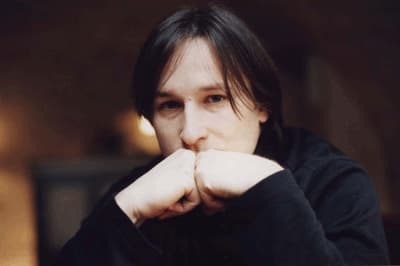
Alexei Aigi (born 1971) is a composer, conductor, performer and producer. He was born in Moscow and graduated from the conservatory in violin.
Alexei Aigi is often called the Russian Michael Nyman. Unlike the maestro from across the ocean, the son of the great poet Gennady Aigi has never overused the word "minimalism". His light passages score Dykhovichny's "Music for December" and the younger Todorovsky's "Country of the Deaf".
In 1994 Alexei founded the ensemble 4'33", one of the most interesting musical projects of recent years. The 4'33" ensemble takes part in festivals of contemporary academic music as well as rock and jazz festivals, occupying a strange place in the contemporary musical landscape.
Alexei Aigi is also known as a talented composer. He has written the music for several films; in particular he wrote the score for Valery Todorovsky's "Country of the Deaf", for which he received the Golden Aries national film press award and was nominated for the Nika as best composer. He has also written music for silent films shown in the series "Silent Cinema, Talking Music" (Alexander Medvedkin's "Happiness", 1934), for Boris Barnet's "The House on Trubnaya", and for the television series "Kamenskaya".
The 4'33" ensemble was founded in 1994 and remains the only musical collective in Russia whose creative practice is aimed at overcoming the narrow frames of existing musical movements.
The ensemble pursues the idea of expanding creative space, of removing the rigid linguistic and social borders between the movements and genres of new music. Using a non-traditional repertoire, or a non-traditional approach to the traditional repertoire, the ensemble creates its own open artistic field in which the academic avant-garde and post-avant-garde, minimalism and spontaneous improvisation, instrumental theatre, jazz and rock, the music of young Russian composers and of established Western authors, European and non-European traditions, academic and marginal standards all interact. The ensemble is not an attempt to compile the old or invent the new, but a search for wholeness and openness in the context of contemporary musical art.
The 4'33" ensemble, named after John Cage's famous silent piece, is a mobile, open structure. Depending on the concept of each project it forms ensemble groups of larger or smaller size.
The ensemble strives to play on contrasts of styles and genres: a special place in its repertoire belongs to original recompositions of the classics, from the old masters to well-known rock authors. The repertoire includes works by Philip Glass, Morton Feldman, La Monte Young, Terry Riley, Christian Wolff, Brian Eno, Toru Takemitsu and others, as well as the newest works by Russian authors: Vladimir Martynov, Georgs Pelēcis, Arvo Pärt. The composers of the "new Russian wave", who develop the ideas of the world neo-avant-garde in their own way, also write specially for the ensemble: Anton Batagov, Ivan Sokolov, Iraida Yusupova.
The ensemble made a successful debut in April 1994 at the Seventh Moscow International Festival of Contemporary Music "Alternativa", performing Alexei Aigi's "In Memoriam Witold Lutoslawski". In May 1994 the 4'33" ensemble performed at the international music theory conference devoted to the millennium of Guido d'Arezzo, presenting for the first time in Russia works by American avant-garde composers written in non-traditional notation. In autumn 1994 the ensemble took part in the First Moscow Festival of Performance with an audiovisual project based on a synthesis of graphics and music, improvisation and composed structures. At the "Anthology" festival at the Moscow Centre for Contemporary Art in March 1995 the ensemble took part in the action "Mummification of Sound" together with the French pianist Patrick Scheyder and the artist Mikhail Roshnyak. In spring 1995 a CD was released with Anton Batagov's music for Ivan Dykhovichny's film "Music for December". At the "Alternativa" festival in May 1995 the ensemble served as the house collective, preparing several programmes: world premieres of works by Anton Batagov and Vladimir Martynov, transcriptions of rock music and of works by Béla Bartók, and Russian premieres of foreign authors of the second half of the twentieth century.
Both the group's line-up and its music presuppose collaboration of any kind, from a rock band to a large symphony orchestra. In the nineties Alexei Aigi's ensemble opened the series "Silent Cinema, Talking Music", in which it began to score films made before the arrival of sound. The ensemble has also worked with Lev Rubinstein, Dmitry Prigov and Andrei Bitov.